


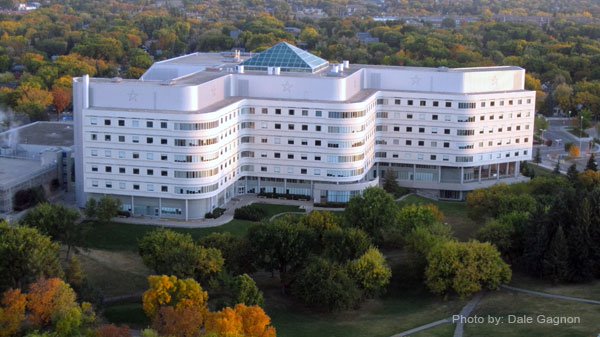
Dr. Brendan Kushneriuk, Dr. Shane Wunder (Program Co-Directors)
Directeur(trice) du programme
Julie Gillis
The University of Saskatchewan Department of Physical Medicine & Rehabilitation is a provincial program that provides a unique and flexible opportunity to take advantage of the best training opportunities across two main campuses, located in the cities of Saskatoon and Regina, as well as opportunities to experience one or more of the regional centres throughout the province. We currently have residents in various stages of training who have their primary base in either Regina or Saskatoon. For 2027, we will have one position based primarily at each of the two training sites of Saskatoon and Regina. Residents training at both sites will still be expected to complete part of their training at the other campus to take advantage of the strengths at both locations and the diversity of faculty and patients across our province.
We have integrated support for research with access to research scientists in both cities. We have strong working relationships with neurosciences, rheumatology and orthopedics. Both centres have established services in the core rehabilitation areas of stroke, spinal cord injury, brain injury and amputation medicine.
Our two tertiary rehabilitation centres in Saskatoon and Regina serve a provincial population of over 1.2 million. Our program is distributed between both cities, which offers the best of flexibility, personalized attention, and practical experience. There is excellent support from the College of Medicine to support this distributed model. We have a strong focus on neurological and musculoskeletal anatomy reinforced by five half days per year in the College of Medicine anatomy lab guided by an anatomist and physiatrist. This is followed by hands-on ultrasound teaching and practice evaluating the anatomy reviewed in the lab. We are continuing to build our expertise for integrating ultrasound into spasticity management and musculoskeletal procedures. We also have optional EMG teaching rounds in addition to our regular academic teaching program.
At the Regina campus, the program is primarily based out of Wascana Rehabilitation Centre, a stand-alone rehabilitation facility which has all core rehabilitation services at one site including inpatient and outpatient rehabilitation services, electrodiagnostics, prosthetics and orthotics, specialized seating, and services for pediatric rehabilitation.
The campus in Saskatoon is based out of Saskatoon City Hospital, where there are inpatient and outpatient rehabilitation services. There is also the opportunity to work with off-site pediatric subspecialists as well as teams managing cerebral palsy, spina bifida and other neuromuscular diseases in addition to orthotics and prosthetics.
There are also seven community physiatrists in Saskatoon and one in Regina who see a mix of musculoskeletal and electrodiagnostic medicine.
Saskatchewan | |
|---|---|
Gross annual PGY-1 Salary | $61,635 |
Gross annual PGY-2 Salary | $67,217 |
Gross annual PGY-3 Salary | $72,794* |
Gross annual PGY-4 Salary | $78,348* |
Gross annual PGY-5 Salary | $83,860* |
Gross annual PGY-6 Salary | $89,359* |
Educational Leave | Minimum 7 days with pay, 12 Maximum |
Annual Vacation | 4 weeks |
Meal Allowance | n/a |
Frequency of Calls | 1:4 in-house (if in excess of 1:4 paid $196/period from 1700-0800 weekdays and $249 from 0800-0800 weekends)* 1:3 out-of-house |
Maternity Leave / Paternity | In conformity with Sask. Labour Standards Act – 17 weeks max maternity leave and up to 35 weeks parental leave. 5 paid days paternity (can split the 35 weeks parental leave with mother as desired.) |
Supplemental Maternity Leave Benefits | 15 weeks topped to 90% pay when eligible for Employment Insurance |
Provincial Health Insurance | Yes, if registered with Sask. Health |
Extended Health Insurance | Blue Cross family coverage, if registered with a Provincial Health Plan |
CMPA Dues Paid | 100% |
Dental Plan | 100% |
Statutory and Floating Holidays | 1.5 times pay or 1/2 pay & day off for stats, plus 6 extra paid days off at Christmas |
Long-Term Disability Insurance | Paid premium cost for Disability Insurance |
Life Insurance | Paid premium, >$100,000 coverage |
Sick Leave | 1.25 days per month to maximum 75 days |
Provincial Dues (% of salary) | 1% |
Employee Assistance Program | Two programs available through SMA and University of Saskatchewan |
On-Call Stipends | Home Light: per duty period: $72 weekday; $83 weekend In House: per duty period: $166 weekday; $191 weekend ICU/CCU: per duty period: $166 weekday; $191 weekend |
Updated August 24, 2022
*Effective January 1, 2021
Term of Collective Agreement – visit http://www.residentdoctorssk.ca/contract/current-collective-agreement for contract details.

Yes, please email our administrative residents – Teagan Holt (tjh419@mail.usask.ca) or Greg Nixon (qha235@mail.usask.ca) — if you have any questions.
We have made several changes in the last couple of years including bi-weekly optional EMG rounds, a patient safety and quality improvement course integrated into our academic teaching curriculum, and 5 sessions of applied ultrasound and anatomy focused on a specific body region.